Carbon Footprint Mug
Brand Name:河北美术学院
Design Company Name:河北美术学院
Nationality / Region:China

Entry ID:2025-07-6562176
Entry Category:Concept_Group
Categories:Future Scenario
Introduction
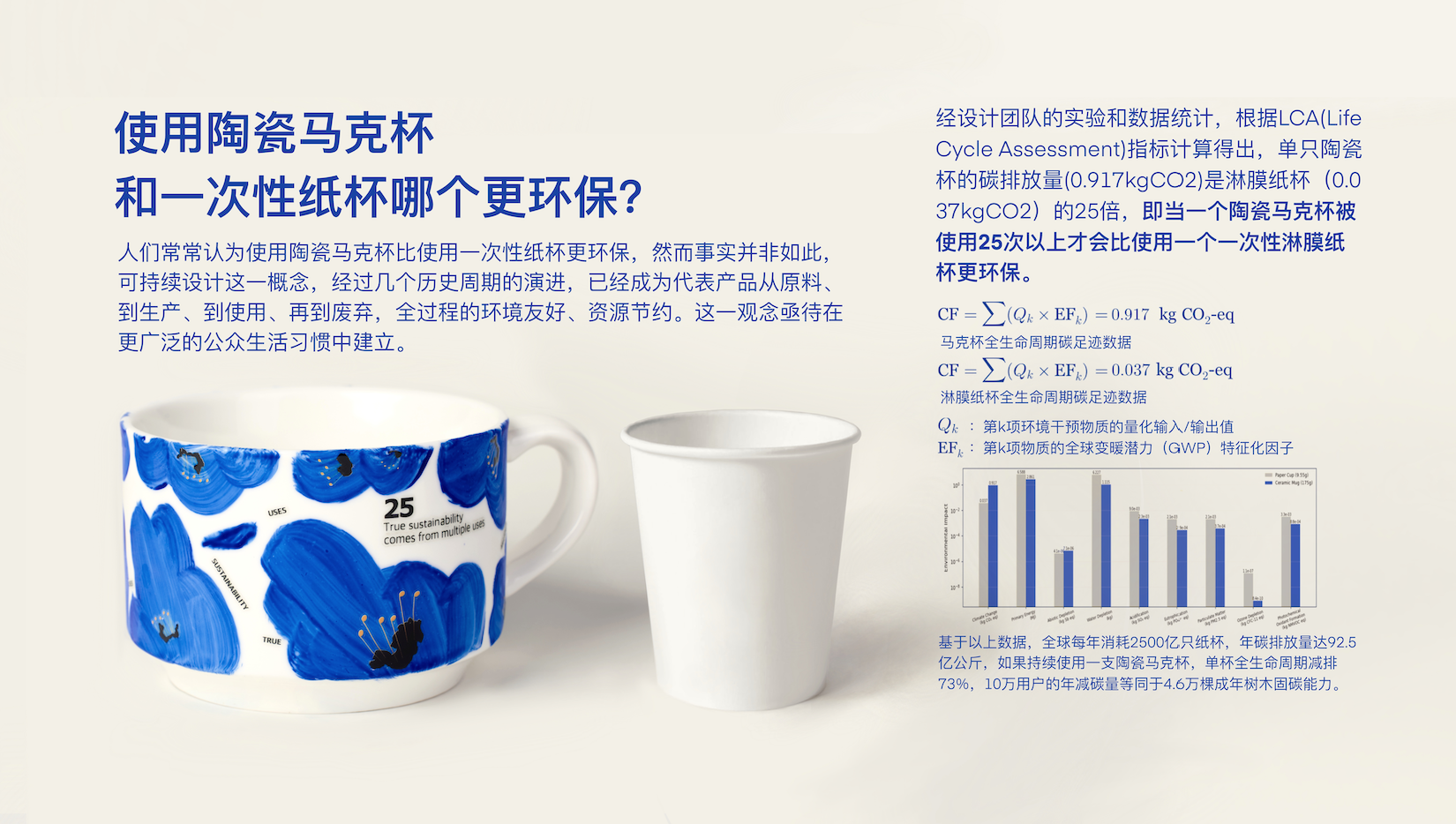
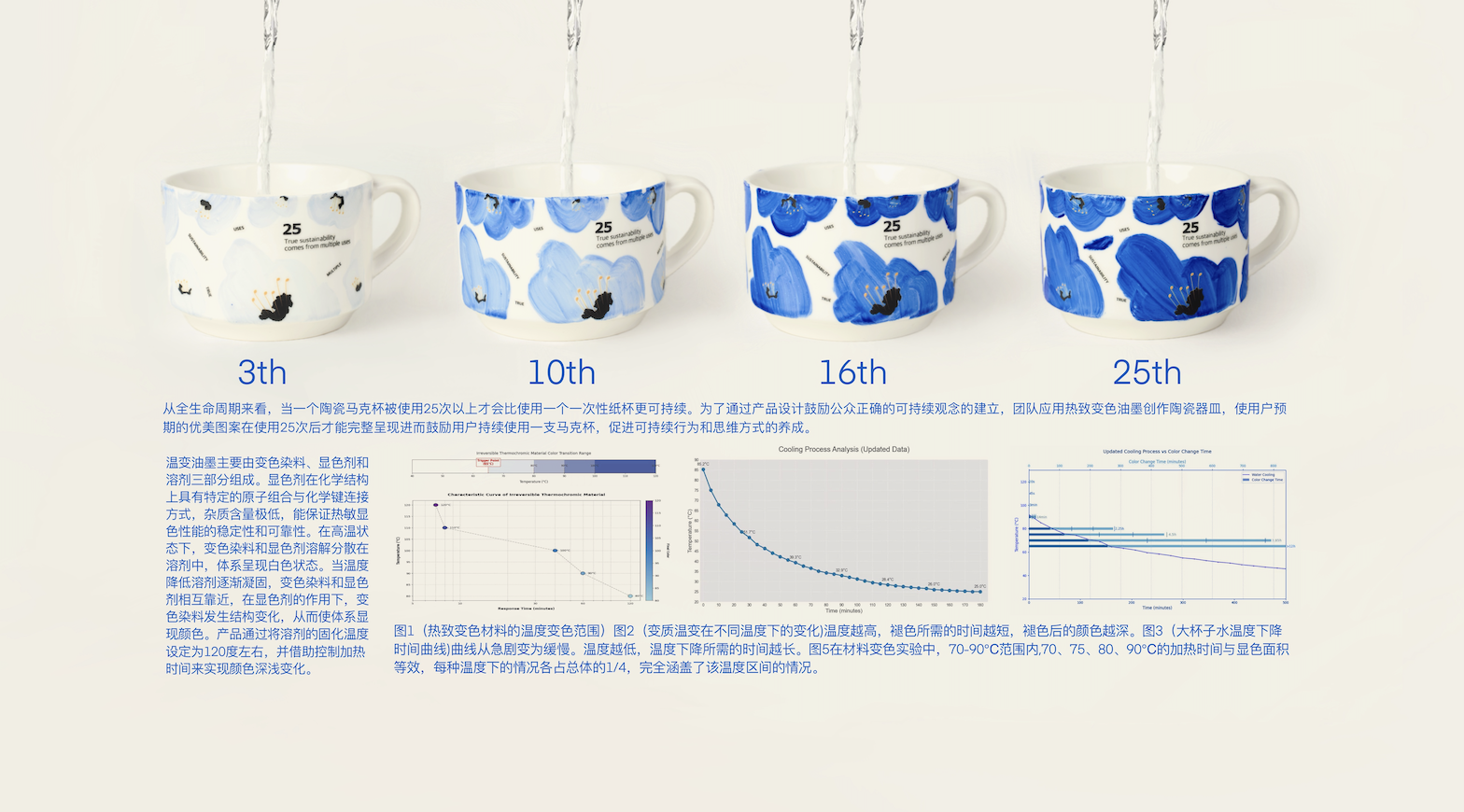
Carbon Footprint Mugs — Visualizing Carbon Footprints to Encourage the Public to Build Sustainable Mindsets People often believe that using ceramic mugs is more environmentally friendly than using disposable paper cups, but the fact is otherwise. Sustainable design is a design practice aimed at environmental sustainability, considering the entire lifecycle of a product or service—from raw material acquisition, production, distribution, use to final disposal. This approach aims to reduce negative environmental impacts while meeting social and economic needs.According to the experiments and data statistics of the design team, calculated based on the LCA (Life Cycle Assessment) indicators, the carbon emission of a single ceramic cup (0.917kgCO2) is 25 times that of a film-coated paper cup (0.037kgCO2). That is to say, when a ceramic mug is used more than 25 times, it will be more environmentally friendly than using a disposable film-coated paper cup.Through the design concept of carbon footprint visualization, the public is encouraged to establish correct sustainable concepts. The team innovatively applies thermochromic inks to create ceramic tableware, so that the expected beautiful patterns can only be completely presented after 25 uses. This approach further encourages users to continuously use a single mug, promoting the cultivation of sustainable behavioral habits and ways of thinking.This design provides a design method to visualize carbon footprint through innovative material applications. This design strategy can be applied to more utensils and even broader scenarios, calling on users to continue using daily necessities.Based on the above data, 250 billion paper cups are consumed globally each year, resulting in an annual carbon emission of 9.25 billion kilograms. If a ceramic mug is continuously used, the carbon emission reduction throughout its entire life cycle can reach 73%. The annual carbon reduction of 100,000 users is equivalent to the carbon sequestration capacity of 46,000 adult trees.